What is the Agency Crisis in Higher Education?
The agency crisis is an organisational pattern where university teams are unable to turn strategy into action because institutional culture prefers certainty, central approvals, and complex planning before people feel able to act. Overcoming this requires shifting from top-down control to collective agency, that’s built on psychological safety, individual confidence, and space to experiment.
On this page
Spend any amount of time working in Higher Education right now and you’ll hear the same pressures being discussed: financial constraints, changing student numbers and expectations, technological disruption, AI, increasing complexity and the continuing challenge of doing more with less.
There is no shortage of analysis. There are strategies, reviews, consultations, transformation programmes and plans.
And yet, despite all that activity, progress on change can feel remarkably slow.
This isn’t because people don’t see the problems, or because they don’t care about them. More often, it seems to be a consequence of the way universities respond to uncertainty.
When something important needs to change, the instinct is to make the uncertainty safer by adding more structure around it: understand the problem more fully, get alignment, develop the business case, secure sponsors, agree the plan, establish the project and then, eventually, start doing something.
All of those things can be sensible. The difficulty comes when they become prerequisites for action.
In a complex environment, the information you need to decide what to do next often doesn’t exist until you start doing something.
That can leave HE organisations caught in a strange loop: the more uncertain the situation becomes, the more certainty they try to create before acting, even though the action itself may be what generates the information they need.
This is one reason we’ve become increasingly interested in agency in HE: not as another leadership competency, but as a way of understanding what helps people move from seeing a problem to doing something about it.
If this feels familiar, three pieces from our work explore different parts of the problem:
- Why agency is evaporating and what to do about it – looks at what happens when people gradually lose the sense that they can influence what happens around them, and why that can become a systemic problem rather than an individual one.
- Why waiting for certainty keeps change stuck in HE – explores the tendency for people to wait until they feel sufficiently certain, confident or prepared before taking the first step, even when taking that step is what would give them the information they need.
- The fallacy of planning – looks at what can happen when the attempt to create a better plan starts to displace the conversations and experiments that might actually help you understand what needs to happen.
The rest of this guide brings these ideas together, and explores what it might take to create the conditions for more people to act.
What do we mean by agency?
Agency is the capacity to act: to use your judgement, make decisions and do something about the situation you’re in.
It sounds straightforward, but in practice agency is more complex than simply giving people more autonomy.
People often think about agency as though it is something an individual possesses. Someone is confident, capable and willing to take responsibility, so we say they have agency. Someone else is cautious, uncertain or waiting for permission, and we might conclude that they lack it.
But agency isn’t simply something that people possess.
It is shaped by context.
You might be highly confident and capable within your own team, but become much more uncertain when working across a faculty boundary. You might have considerable expertise, but be cautious when the hierarchy around you is particularly pronounced.
The person hasn’t changed.
The context has.
That matters because if you want more agency in your organisation, empowering people isn’t going to be enough. You need to look at the conditions in which people are being asked to act, as well as to the confidence and capability of the people themselves.
In our experience, three conditions seem particularly important:
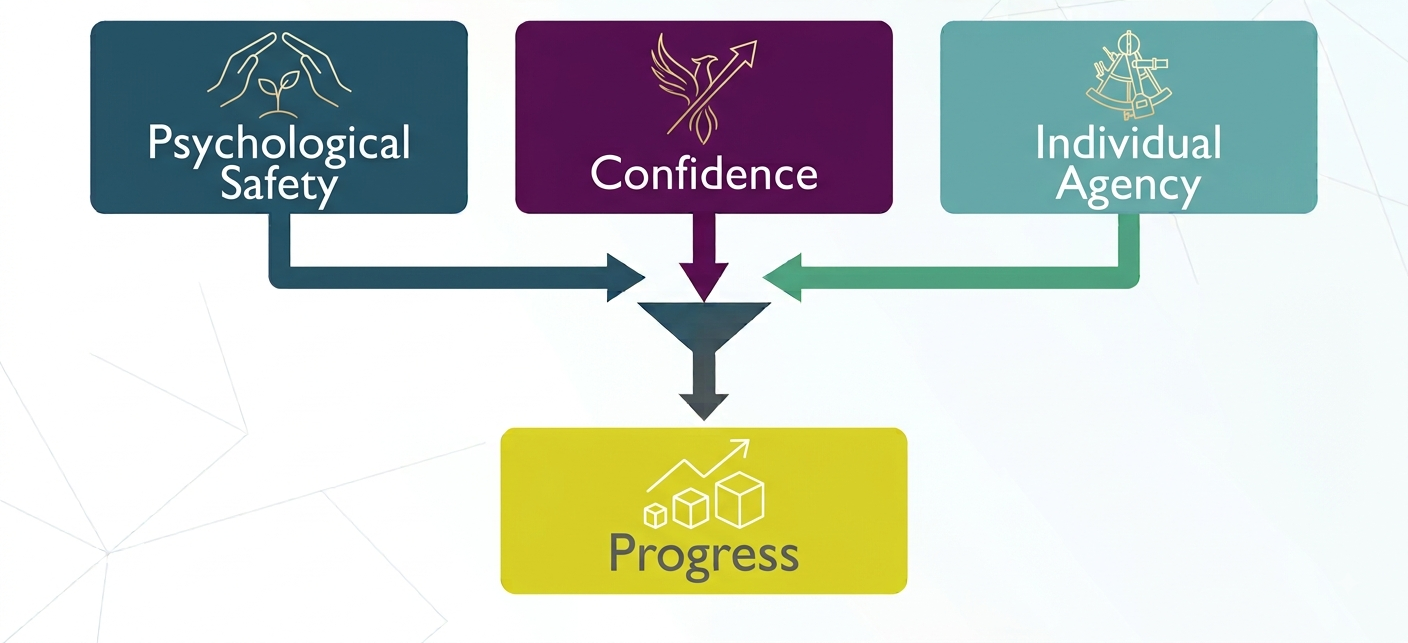
Safety
Feeling able to speak openly and honestly about what you think and feel, including being able to admit mistakes, ask questions and disagree with authority, especially when it is inconvenient or challenges the prevailing view.
Confidence
Believing that you have something useful to contribute, that your contribution is valued and that you can exercise judgement without letting self-doubt stop you.
Agency
Having enough clarity, authority and room to make choices and act on what you know, rather than constantly waiting for someone else to tell you what to do.
These aren’t three independent ingredients. They interact with one another.
If people don’t feel safe, they may not speak up. If they don’t have confidence, they may defer to someone else even when they have something valuable to add. And if they have neither the authority nor the opportunity to act, safety and confidence don’t get very far.
But agency is more than an individual capability.
It isn’t just something that happens inside a person.
It is shaped by the environment and by what happens between people too: relationships, power, organisational structures and the opportunities people have to act.
And that takes us somewhere slightly different.
Agency is powerful when people act together
Agency is contextual. It is also relational.
Agency is contextual
An individual can have agency in one context and very little in another.
What anyone can do depends partly on who they are working with, the relationships they have, the information available to them, the authority they can draw on and the purpose they are working towards.
This matters particularly in universities because many of the problems that need solving don’t sit neatly within one team or one part of the organisation.
A problem might involve academic colleagues, professional services, different schools and faculties, IT, students and external partners. No one person has all the information, expertise, relationships or authority needed to solve it.
Yet the response can still be to look for someone who does.
And without agency, the organisational response to challenges can be to push the problem upwards ie someone senior needs to make the decision. Someone needs to bring the different stakeholder groups together. Someone needs to sponsor the work. Someone needs to approve it.
Sometimes that’s exactly what is needed. Formal authority matters, and there are decisions that should sit with people who have the responsibility for making them.
But if looking upwards becomes the default response to challenges, people gradually learn that the way to get things done is to find someone with more authority.
That creates dependency.
An alternative is to build the capacity to act together.
Agency is relational
Universities are highly networked organisations, but that doesn’t mean people necessarily know how to use those networks, or feel able to.
There are siloes, competing priorities and boundaries between schools, faculties and professional services can make collaboration difficult, particularly when there is no obvious person whose job it is to bring everyone together or very different understandings of the same problem.
Being able to build relationships, influence others, find shared purpose and bring people together around a problem is not just a useful leadership skill. It is part of an organisation’s capacity to change.
Agency is collective
Collective agency takes this one step further.
People can do things together that none of them could do alone.
Some people bring knowledge of the problem. Others bring technical expertise. Someone has the relationship that opens a door. Someone else has enough influence to bring another group into the conversation.
The power to act doesn’t necessarily sit with any one individual. It can emerge from the connections between them.
But collective agency doesn’t replace individual agency. It extends it.
Collective agency depends on people being willing and able to contribute what they know, exercise their judgement and take some responsibility for what happens next.
We believe this is where coalition building becomes important. A coalition doesn’t require everyone to agree about everything. It needs enough shared purpose for people with different perspectives, expertise and connections to contribute to something that matters to them.
We’ve developed a practical Building Coalitions toolkit that explores some of the mechanics of doing this: what’s needed for a coalition to operate, what to think about when planning them, the various stages and tools you can use to design and prototype solutions, and allow work to move.
We’re developing further thinking about collaborative leadership and collective agency, which we’ll add here as that work develops.
But relationships alone aren’t enough.
People also need to feel able to contribute, challenge what they see and act on what they know.
Creating the conditions for agency
If agency is contextual, relational and collective, what makes it more likely to emerge?
There isn’t a single answer, but three conditions come up repeatedly in our work: people need to feel safe enough to contribute honestly, confident enough to believe their contribution has value, and have enough room to act on what they know.
These conditions are connected, but they are not interchangeable. Someone can feel psychologically safe but have very little scope to act. Someone can have considerable authority but lack the confidence to use it. And a team can have capable, confident people who still struggle to make progress because decisions are concentrated elsewhere.
It is worth looking at each in turn.
i. Psychological safety: can people speak up?
Universities depend heavily on professional knowledge and expertise, yet hierarchy can make it surprisingly difficult for people to say what they actually think.
People may see a problem but decide it isn’t theirs to raise. They may have an idea but assume someone more senior will know better. They may recognise that something isn’t working but stay quiet because previous attempts to challenge the status quo haven’t gone well.
This isn’t necessarily about a lack of courage or commitment.
People learn from the environments around them.
If speaking up tends to result in being dismissed, ignored or labelled as difficult, people will quite reasonably become more cautious about speaking up. And if that happens often enough, the organisation loses access to information it already has.
Psychological safety isn’t about making work comfortable or avoiding disagreement. In practice it is about creating the conditions in which people can ask questions, suggest ideas, challenge, contribute and surface inconvenient information without fearing that doing so will leave them feeling humiliated, rejected or damage their position.
That matters because the information people are least comfortable sharing can sometimes be the information an organisation most needs to hear.
It also has a direct bearing on institutional speed. Problems that are identified early are usually easier to deal with than problems that have been allowed to become embedded, and organisations that can discuss mistakes and what isn’t working are better placed to learn and adapt.
If this is something you’re exploring, these articles look at different aspects of the relationship between safety, challenge and change:
ii. Confidence: do people believe they can contribute?
Feeling safe enough to speak is one thing. Believing that what you have to say is worth hearing is another.
Confidence is less about having all the answers and more about having enough self-belief to trust yourself. This affects whether people put forward an idea, offer a different perspective, take a position or step up for something they haven’t done before.
It can be surprisingly fragile in organisations where expertise and authority are strongly associated with hierarchy.
If people’s ideas are routinely dismissed, belittled or simply not listened to by someone senior, they can start to doubt their own judgement. If people are repeatedly criticised when they get something wrong, they may become more cautious about putting themselves forward. And if the safest response is simply to do what has been asked without questioning it, people have fewer opportunities to develop the confidence that comes from exercising their own judgement.
This isn’t about blaming leaders for undermining confidence, or suggesting that people simply need to be more confident. These patterns can emerge gradually, often without anyone intending them to.
Confidence is shaped by experience.
When people have opportunities to contribute, to try things, to get useful feedback and to see that their contribution has made a difference, they have the opportunity to build a more grounded sense of their own capability. Positive feedback matters, not as reassurance for its own sake, but because it gives people evidence that their judgement and contribution have value.
Sometimes that means helping less.
Instead of immediately providing the answer, ask what someone thinks. Instead of taking responsibility for a problem, ask what they think should happen. And when someone does something well, be specific about what you noticed and why it was useful. That kind of feedback can help people recognise their own strengths and become more confident in exercising their judgement.
The aim isn’t to leave people to work things out for themselves. It is to give them enough support and enough room to discover, through experience, that they are capable of more than they may have assumed.
Confidence doesn’t mean feeling certain.
In fact, some of the most useful confidence is the confidence to act while still knowing that you might get something wrong, and to remain open to what you can learn from what happens next.
If you’re interested in how this plays out in leadership and development, these pieces explore some of our thinking:
iii. Agency: can people actually act?
Safety and confidence matter, but neither is enough if people still can’t act.
You can have a team that feels able to speak honestly, and individuals who have confidence in their own judgement, but still find that very little happens because decisions are concentrated elsewhere, responsibilities are unclear or every significant step requires another layer of approval.
This is where organisational structures and everyday practices become important.
What we often see in universities is a gap between people being given responsibility and not actually having the conditions to exercise it. Decisions continue to be made centrally or several levels above. Or people may be encouraged to innovate, but find that even relatively small experiments require multiple approvals.
The result is people learn to escalate: when something is difficult, decisions are pushed upwards.
When the system repeatedly teaches people that important decisions sit somewhere above them, seeking permission becomes a rational response.
One alternative is to create more room for local experimentation.
That doesn’t mean abandoning strategy or accountability. It means recognising that, in complex environments, you often discover what the right response is by trying something, seeing what happens and adapting.
A small experiment can generate information that another six months of planning cannot.
The question is not always how to make change happen faster. Sometimes it is about creating enough space for people to take the next useful step, learn from what happens and decide what to do next.
There is a balance here.
Too little freedom and people wait for permission. Too much freedom without clarity can create confusion, duplication or risk.
The task is not to remove structure, but to make the boundaries within which people can act clear enough that they don’t have to keep asking where those boundaries are.
If you’re interested in this way of working, these pieces explore some of the thinking and practice behind it:
Collective agency in practice
Collective agency can sound abstract until you see it happening.
We’ve seen it develop repeatedly in our rapid improvement work, where groups come together in coalitions to work on problems that affect them directly.
Often, those problems initially appear to require a significant intervention: a new system, a substantial investment or a decision from somewhere higher in the organisation.
Bringing together the people who are actually involved in the work often changes the nature of the problem.
Someone knows how the process really works.
Someone else understands the technology.
Someone has a relationship with another team that needs to be involved.
Someone has tried something similar before.
Once those connections are made, the group doesn’t necessarily produce a perfect solution. It starts somewhere, learns from what happens and changes its approach as it learns.
The important outcome isn’t only the immediate improvement.
People stop thinking about the problem as belonging to another team, another department or another part of the institution.
People discover that they can influence something they previously assumed belonged to somebody else. They discover who else can help. They build relationships across boundaries. They begin to see themselves as people who can make things happen rather than people waiting for someone else to make them happen.
And that has an effect beyond the original problem.
One successful experiment makes another seem possible. A new relationship makes the next cross-boundary conversation easier. Someone who has discovered they can influence one part of the system may be more willing to try somewhere else.
This is what collective agency looks like in practice.
Not a grand programme of empowerment, but people discovering that, together, they can do more than they thought they could.
To explore this way of working in more detail:
Our Rapid Improvement work describes the practical methods we’ve used to support these kinds of projects.
We’re also continuing to develop our thinking around collaborative leadership and collective agency, and we’ll share more of that work in the coming months.
Large-scale organisational change often attracts much of the attention in Higher Education.
Strategies are rewritten, structures are redesigned, new initiatives are launched.
But much of what shapes agency is also shaped by everyday practices.
It happens in conversations, in meetings, in the way decisions are delegated and responsibilities are defined.
Are people clear about what they are responsible for? Do they know where they have discretion and where they need to involve others? Are they getting useful feedback? Are leaders delegating responsibility or simply passing on tasks?
These things can sound relatively mundane compared with institutional transformation, but they have a direct effect on whether people feel able to exercise judgement and take responsibility.
We’ve developed a number of practical tools that can help:
Role clarity
People find it difficult to exercise agency when they aren’t clear about what is expected of them, where their responsibility starts and ends, or which decisions they can make themselves.
Take a look at our guide to running a Role Clarity exercise, it looks at some of the questions that help make those boundaries clearer without turning them into another layer of bureaucracy.
Feedback
Feedback can either reinforce dependency or build capability, depending on how it is used.
If feedback simply tells someone what they did wrong, they’re left waiting for the next instruction. But when it helps people understand what happened, what they might try differently and what they can learn, it builds their capacity to judge for themselves.
Our article, How NOT to give feedback to your staff, explores some of the ways feedback can unintentionally undermine development and what to do differently.
Delegation and CPORT
Delegation is often described as a way of freeing up a leader’s time.
But delegation can also create opportunities for people to exercise judgement and take responsibility, provided they are clear about what they are being asked to achieve and the boundaries within which they can act.
Read our CPORT approach to delegation – it provides a simple framework for doing that more deliberately.
Circle of Influence
It is easy to spend time trying to change things that are outside your control, particularly in large organisations where there are plenty of legitimate frustrations.
Circle of Influence is a simple way of shifting the conversation towards what people can actually influence, and what they might do with that influence.
Three Questions
Sometimes the most useful intervention is simply to understand what people need in order to move forward.
Our Three Questions approach gives leaders a straightforward way to explore what’s working, what’s getting in the way and where support might be useful.
None of these tools solve the agency problem on their own.
They’re practical ways of translating ideas about safety, confidence and agency into everyday practice.
Rethinking leadership in Higher Education
We started with a fairly simple observation: universities know a great deal about the challenges they face, yet often struggle to turn that knowledge into movement.
It is tempting to conclude that the answer is better leadership.
Sometimes it probably is.
But the more we work with universities, the less convinced we are that the answer lies simply in asking senior leaders to make better decisions, communicate more clearly or work harder.
The lack of progress within HE is not a consequence of a disinterested workforce.
It is, at least in part, the predictable outcome of structures and habits that have prioritised control over capability.
And yes, formal authority, governance and accountability still matter. There will always be decisions that need to be made by people with particular responsibilities.
But leadership isn’t always about holding the power.
Sometimes it is about creating the conditions in which people have the confidence to exercise their own power, expertise, and the relationships they already have.
So instead of asking: How do I empower people?
you could ask: How do I create the conditions in which people can act together?
That is a different way of thinking about leadership, and it has implications beyond any individual change programme.
If more people can speak honestly about what they see, believe they have something useful to contribute, and have enough room to act, the institution will have more capacity to respond to the changing landscape.
And if those people can connect their agency with others, organisational capacity grows.
Perhaps that is the shift we need to make: from thinking about agency as something we give people, towards distributed leadership and thinking about the conditions that allow agency to emerge.
That doesn’t happen through a single big intervention.
It is more likely to happen through a series of small changes in how decisions are made, how relationships are built, how people are involved and how much room they have to act.
Then, gradually, the organisation becomes a little more capable of responding for itself.
And perhaps that is when change starts to move.
If you’re interested in our approach, this article explores how small steps, experiments and a stronger sense of agency can help HE teams move forward.
Key Takeaways: Unlocking Agency in Universities
- The certainty challenge: University change stalls because organisations want certainty before acting, even though critical information only emerges after action begins.
- 3 conditions of agency: Sustained progress requires Psychological Safety (freedom to speak up), Confidence (trust in one’s capability), and Agency (clarity and authority to decide).
- Agency is collective and relational: Real transformation relies on cross-boundary coalitions, shared purpose, and networked leadership rather than isolated individuals.
- Everyday micro-practices: High-level strategy can be supported by practical everyday habits like CPORT delegation, explicit role clarity, and the Circle of Influence.
Restoring agency and momentum in Higher Education: