
If you’re a leader in Higher Education (HE), you know how quickly problems gravitate upward. With the best of intentions, it’s easy to become the ‘Fixer-in-Chief – the person every decision depends on. But what if helping your team less is actually the secret to developing them more?

Photo by Memento Media on Unsplash
What if helping your team less is actually the secret to developing them more?
It’s a counterintuitive question, but a critical one for any leader in HE.
Because often the instinct to help comes from a desire to create clarity and momentum. Yet, according to data from Gallup, only about 50% of workers strongly agree that they know what is expected of them.
When role clarity is lacking, problems inevitably gravitate upward. With the best of intentions, it is incredibly easy to become the ‘Fixer-in-Chief’ – the person every decision depends on.
Most leaders in HE do not set out to create dependency.
In fact, the opposite is usually true: they want capable, confident teams who can take ownership and move work forward without constant oversight.
Yet, many leaders find themselves pulled into more and more meetings, not because they want to be there, but because things do not seem to move without them.
However, if ownership is unclear and feedback is in short supply, then helping more can become part of the problem rather than the solution. This leads to the creation of bottlenecks and a reduction in agency.
A leadership trap: when helping becomes a bottleneck
This bottleneck dynamic builds through a series of small, reasonable interventions.
A colleague brings a problem; you offer advice. A piece of work is drifting; you step in to get it back on track. A decision needs to be made; you make it to avoid delay.
In the moment, it feels like good leadership. The work progresses, the issue is resolved, and the team is supported. But over time, these rescues shape expectations.
People begin to defer decisions they could have made themselves. You find yourself solving more problems while your team learns less from them.
Each time you step in, you inadvertently remove a potential learning moment.
Psychologists call this the Parent-Child dynamic. When you act as the protective, omniscient Parent who fixes every problem, you inadvertently force highly capable adults into the role of dependent children. Breaking this cycle isn’t just about changing tasks, it’s about shifting the psychological contract.
Stepping back entirely is not the answer, but continuing to step in, in the same way, tends to reinforce the pattern.
Why decision-making isn’t the real problem in HE
Leaders across many organisations often tell us they step in because in their minds there is a problem with decision-making. Decisions take too long, they say, too many people are involved, or issues are repeatedly escalated.
But if we ask about specific examples, the real issue usually turns out to be that colleagues have a lack of role clarity and don’t believe they have ownership.
Because it is often not clear where the bounds of someone’s authority sits, or who makes the decision when there is a choice to be made.
Especially when projects bring together people from different functions. If the roles within the project itself have not been explicitly defined then decisions are passed upward not because people are unwilling to take responsibility, but because the limits of their territory make them reluctant to make asks of people in other teams.
Navigating the complex web of a modern HE organisation
The problem is not a lack of skill.
In the complex web of HE – where professional services, academics, and policy teams overlap – people are often afraid of treading on toes or embarrassing a stakeholder. They don’t have the license to operate autonomously. Escalation becomes a safety mechanism.
The consequence is that senior people are drawn into operational detail, and the organisation becomes more dependent on them than it needs to be.
When politeness smothers expertise in university culture
We recently worked with a professional services team – highly capable experts in their field – who had fallen into this trap. Because a feature of HE is a hierarchical culture that values people being agreeable, the team had become chronic ‘order-takers.’ When senior colleagues requested a specific output, the team delivered exactly what was asked for. Out of deference to the formal authority of their requesting colleague, they didn’t ask the purpose of the request or enquire about the desired outcome.
And similarly they didn’t engage their technical expertise, which could have identified that what was being asked for wouldn’t actually solve the underlying issue.
Out of a desire to be helpful and polite, they were effectively squashing their own expertise.
The consequence? Senior leadership began to view them as middle-of-the-road and uninspired, unaware that the team was just politely executing flawed briefs.
Worse, the senior leadership were right.
Everyone was being perfectly nice, yet the organisation was starved of the very expertise it needed.
High support vs. healthy jeopardy: moving teams from fragility to confidence
This reality can expose a dilemma for HE leaders. When you inherit a team that is underconfident, fragile, or used to lying low, you may find yourself paralysed by conflicting and valid leadership instincts.
You want to shield them from potential harm from the organisation’s impatience or institutional politics. You also want them to recognise their jeopardy and step up. How do you move them from fragility to confidence?
Ultimately protection without stretch only breeds further fragility.
In many HE cultures, accountability is an alarming idea. Leaders and managers fear that blunt feedback will cause a backlash or induce panic. But leaving expectations fuzzy isn’t a kindness – it’s a disservice.
If a team doesn’t realise that the organisation is losing patience with their lack of initiative, they will continue to quietly operate under the radar until a crisis hits.
Your job as leader or manager is not to eliminate all jeopardy, but to introduce healthy friction and compassionate clarity.
We have to stop protecting our teams from the organisation and start equipping them to lead within it. That means being honest about where they are falling short, while providing the safety net they need to raise their game.
Case study: building agency through cross-functional coalitions
Recently we’ve been supporting teams with Rapid Improvement Projects. These are great models for helping people find their own agency.
In these projects the issue being addressed is interdependent with elements of the work linking across multiple teams. No team has responsibility for the end to end process.
Example: streamlining student deadline extensions
One example addressed time-intensive manual processes resulting from student requests for deadline extensions. Identifying an intervention that saved time and improved the student experience meant understanding the needs and constraints of different schools, institutional policies, IT resources and infrastructure, communications, and multiple academic and professional services teams.
Navigating that complexity was made easier when people formed a multidisciplinary team, to listen carefully, build networks, manage politics and resourcing and roll their sleeves up. Success required pragmatism, compromise and the willingness to engage with ambiguous (or no) authority.
As well as delivering an improvement, the project team members learned so much and their confidence and capability grew. I remember in one project a member of the group said coming to the meeting was like arriving home, it was where they felt safest, where they belonged. I was surprised by how much the project had shaped their sense of themselves and how it was different, better, in the project space than in their ‘day’ job.
The Manager’s Toolkit: designing an environment for agency
So instead of telling people to step up, what is needed is an environment where stepping up is possible and politically safe. This means moving away from simply making the decision, solving the problem, giving instructions, and toward giving people the safety, space and confidence to do so themselves.
This is an opportunity to shift towards Adult–Adult relationships – where responsibility is shared, expectations are explicit, and people are supported to act within a clear frame, rather than waiting for permission.
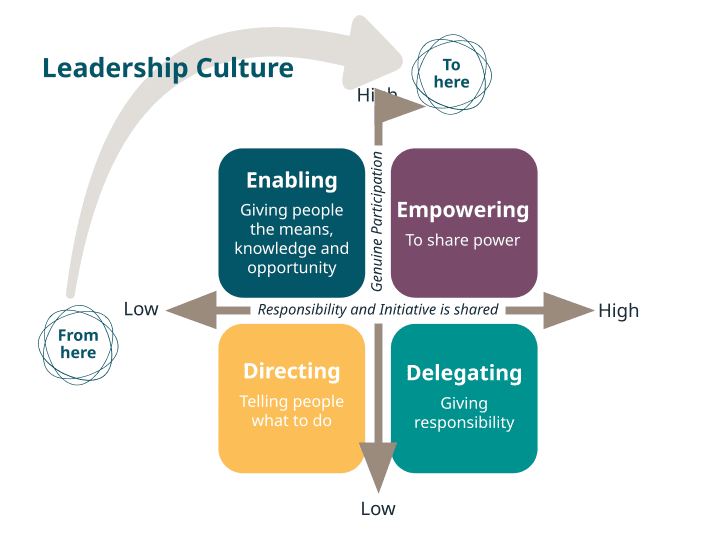
The Leadership Culture framing is a useful way of thinking about it. It alerts you to the possibility that individuals in your team might be starting in different quadrants, and might need different things from you to find their agency and confidence.
The question to ask yourself, the experiments to run, are about what you might do or say differently to help your colleagues spend more time in the appropriate quadrant.
The simple answer is to say that when expectations are clear, authority is understood, and support is available, people are more able to decide, act, and take responsibility.
When those conditions are absent, hesitation and escalation are entirely rational responses.
And it’s also worth saying: the truth is expectations are rarely clear, or they are in conflict. Authority often needs to be dismantled, borrowed or adapted: it is often fuzzy, fickle and ambiguous. And that can actually be useful because there is more room for manoeuvre than org charts imply. Support isn’t a given, it’s an emergent quality of relationships with managers, co-workers, good chairing in meetings, allyship, managing conflict safely.
6 Prompts to create the conditions for agency
Before your next delegation or 1-to-1, here are some prompts to help you think through alternate ways to engage that could help you build agency. These questions won’t give you a formula, but they might open up a different kind of conversation:
- Where is this person starting from in the quadrant? [Or in the parent-child dynamic]
- What assumptions are they making about themselves, you, this situation, colleagues needs?
- How would you like them to be showing up and contributing?
- What small steps might help them get closer to that?
- Given that, what might be a good contribution for you to make?
- What might be the consequence of doing what you always do in this situation?
From offering answers to conditions
Every time you solve a problem for someone, you might be stealing a chance for them to grow.
The goal isn’t to be hands-off, but to be hands-on with the conditions (the safety, the clarity, and the political license), so you can be hands-off with the tasks.
The next time a problem lands on your desk, ask yourself: am I helping them progress the work, or am I helping them progress their ability to do the work?
In the complex, ambiguous, messy, creative, wondrous world of Leadership in HE, it is less about being the source of all answers and more about creating the space where answers can be found by those who actually create the value.
Working with leadership teams in Higher Education
At ThenSomehow we help leaders, teams and institutions navigate change, culture and complexity. Our work creates the conditions for better conversations, stronger relationships and more effective collaboration, particularly during periods of uncertainty and transformation.
If you’re exploring how to support teams through change in your institution, we’d be happy to talk – get in touch here.