
If you’re leading change in a university, you’ll know how easily good ideas stall. Teams identify problems, agree improvements are needed, and then wait for the right plan, the right approval or the right moment. This article explores why waiting for certainty can keep change stuck – and how small steps, experiments and a stronger sense of agency can help HE teams move forward, by ThenSomehow director, Steve Rabson Stark.
Leading change in Higher Education: why waiting for certainty keeps change stuck
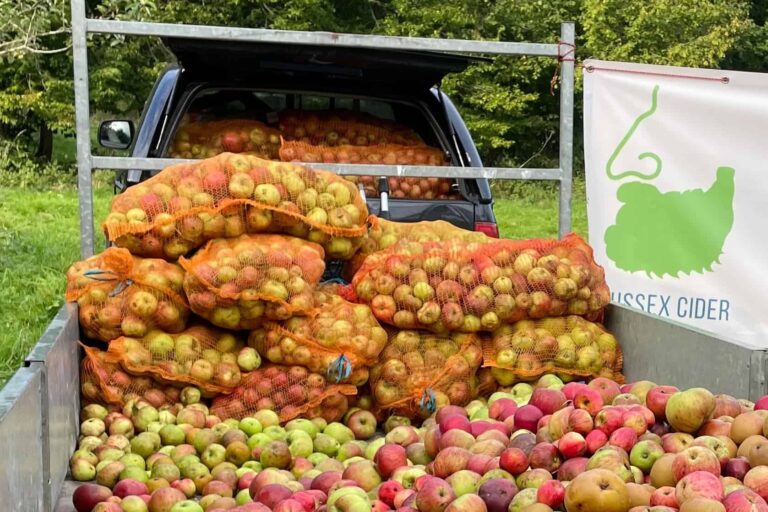
Photo: Sussex apples ready for pressing/courtesy BigNose & Beardy
Photo: Sussex apples ready for pressing/courtesy BigNose & Beardy
What 60 litres of cider taught me about leading change in Higher Education
Alongside ThenSomehow, I co-run a small cider business with my pal Phil.
Phil has a bit of land and a few apple trees, and one autumn about ten years ago we decided it might be fun to make some cider.
We didn’t really know what we were doing. A few school dads turned up, and somehow we ended up with about 60 litres of juice.
It was messy. It was enjoyable. It was a bit of fun.
That first batch eventually turned out to be okay. Not bad but not good either. But it sparked our interest. A friend told us we’d have more luck with a larger fermentation, then sold us some 1,000L tanks and encouraged us to get some proper kit. After much debate, Phil and I bought a press and a scratter. We told ourselves that if it all went wrong we’d sell it and hopefully only lose a bit of money.
We went from 60 to 4,500 litres in one step.
Luckily circumstances worked out: apples kept appearing and there was room in the tanks. Of course, pressing the juice was just the first piece, suddenly we needed a logo, labels, bottles. Then caps. Then boxes.
Only our bottles didn’t fit standard boxes, we needed bespoke ones. Every answer seemed to generate a new question, and require another investment. At this point we hadn’t even got any finished cider!
At no point did we have a grand plan. We weren’t working towards a five-year vision of becoming cider makers. We were simply responding to whatever appeared in front of us next.
Eventually winter turned to spring, the tanks stopped bubbling, and we tasted what we’d made.
Thankfully, it was pretty good and almost by accident we found we had started a business.
Eleven years later we’re still doing it. And there is a community around it that neither of us could have predicted when we started. There are people who bring us apples. People who help us pick. People who come to cider events.
Looking back, it’s easy to tell that story as though we knew where we were heading.
We didn’t. We took a leap and just kept doing the next thing.
Leading change in Higher Education: why transformation often stalls
One of the things that strikes me when working with change in Higher Education is how often people do the exact opposite to that.
A team sees a problem, a process is frustrating, something is wasting time. Everybody agrees it could be better.
And then almost immediately the reasons for not starting begin to appear.
“We need a system…”
“We need approval…”
“We need alignment…”
“We need IT…”
“We need a plan…”
“We need a project…”
“We need someone senior to sponsor it.”
And so the thing that might have been improved gets pulled into a long cycle of waiting.
In hierarchical organisations particularly, people can start to assume they need certainty before they can act. That they need permission before they can experiment. That they need expertise before they can begin.
The result is that uncertainty becomes a reason to pause.
The irony is that most useful change doesn’t begin with certainty at all.
It begins with curiosity. And with somebody deciding to have a look.
What agency looks like in practice: 3 examples from university teams
Over the last few years we’ve supported a number of university teams working on rapid improvement projects. Across all of them, progress happened the moment people stopped waiting for a grand master plan.
1. Solving administrative frustration from the bottom up
One group exploring a problem affecting administrators across multiple departments started with a belief that it would require a major technology investment to solve. The process was consuming huge amounts of time, affecting lots of people, and creating frustration everywhere it touched.
Their original instinct was to build a business case for a new system, for someone else to solve it.
Then somebody asked: why can’t we just fix this ourselves?
So we helped get the people involved into a room and explored what was actually happening.
Much of the problem wasn’t technological at all. Using tools they already had access to – Microsoft Forms, Lists and Power Automate – they were able to create a much simpler admin process. Not perfect, but dramatically better than where they had started.
In the end, the important thing wasn’t the fix they introduced. It was that the group working on it discovered they had more agency than they thought. That they could use that agency to fix other things too.
2. Ditching perfect spreadsheets for OKRs
In another institution we worked with a leadership team that felt disconnected from one another’s priorities. Planning had become a collection of spreadsheets and project lists that nobody could really navigate.
Rather than trying to design the perfect process, they started experimenting with a more conversational approach using OKRs. Just to get them going.
The first version was clunky. Everyone knew it was going to be clunky. But that wasn’t important. They knew they could improve it later.
More importantly, for the first time, people were talking across team boundaries. They could see what other teams were trying to achieve. They could spot overlaps and dependencies.
The process wasn’t successful because it was polished. It was successful because they were willing to start before they knew exactly how it would work. And they learned from that and each year after they made changes and improvements, making it a bit better each time.
3. Organic innovation with AI tools
There was a group at another institution who became interested in whether some AI processing might help with a particular challenge they were facing.
Nobody commissioned the work. Nobody launched a programme.
A couple of people got curious and built something.
At first only a handful of colleagues used it. Then more people became interested. Then managers started asking questions about it.
The thing gained traction because it was useful, not because somebody senior had declared it important.
Across all of these examples the pattern is remarkably similar.
People started without knowing exactly where they would end up. They learned by doing.
Why confidence comes after action (not before)
I think this is the bit we often get backwards. We assume confidence to do things comes first.
Once I’m confident, I’ll act. Once I know enough, I’ll begin. Once I feel ready, I’ll take the leap.
But most of my experience suggests the opposite is true. Action comes first. Then learning. Then confidence.
I say the same thing to people applying for jobs, when their confidence is at a low ebb. The goal isn’t necessarily to get this job. The goal for now might simply be to write an application. Or to get an interview. Or to find out what employers are asking for these days. Not getting that job isn’t a failure, it’s a step on the journey to getting the right job.
Every step gives you information you didn’t have before. Every step changes what you know.
And what you now know changes what feels possible.
You don’t need the answer to begin. You just need to be open to the possibilities.
A core principle: “good enough for now, safe enough to try”
That doesn’t mean throwing caution to the wind. One of the things I’ve learned from working in universities is that the system pushes back when change feels too large or too threatening.
People need time. They need involvement. They need to understand what is happening and why.
If you try to force something through, the system often rejects it.
Which is why I find myself coming back again and again to a simple question when leading change in higher education: what’s the smallest thing you could do that is good enough for now and safe enough to try?
Not the perfect solution. Not the finished product. Just the next step.
The one that teaches you something. The one that generates information. The one that helps you understand the problem a little better than you did yesterday.
Then somehow…
Looking back, our cider business started that way. My consultancy business, ThenSomehow, started that way too.
Culture Catalyst – one of our successful culture analysis tools, now called Cultural Conversations – started that way. Most of the things I’ve been involved in that have gone on to matter started with a degree of uncertainty and a willingness to act anyway.
Not blindly, just without needing to know the endpoint before beginning the journey.
Institutions don’t change because somebody produces a better plan.
They change because enough people discover they have more agency than they thought.
The jump, in my experience, is rarely a dramatic moment. It’s usually a series of small steps that only look obvious in hindsight.
You don’t need the full picture to begin. You just need something that’s good enough for now and safe enough to try.
Then somehow, it becomes something.
A question for your team
If you’re leading change in higher education, what’s one thing in your team, department or institution that everyone agrees could be better, but nobody has started because the solution feels too big, too complicated, or requires someone else’s permission?
What’s the smallest next step that might be good enough for now and safe enough to try?
You don’t need to solve the whole problem. You just need to learn something you don’t know yet.
How ThenSomehow supports Higher Education leaders
At ThenSomehow we help leaders, teams and institutions navigate change, culture and complexity. Our work creates the conditions for better conversations, stronger relationships and more effective collaboration, particularly during periods of uncertainty and transformation.
Here’s how we help:
- Helping teams resolve the dynamics that get in the way of change
- One-to-one mentoring for individuals facing leadership challenges
- Supporting and inspiring cross-functional rapid improvement teams
- Teaching skills for working smarter
If you’re exploring how to support teams through change in your institution, we’d be happy to talk – get in touch here.