
Agency is often treated as an individual capability: something that grows with confidence, competence and autonomy. But in complex organisations such as universities, the power to act also depends on relationships, shared influence and the conditions in which people work together. What can leaders do to help teams develop the collective agency to solve problems and make progress?

Image by A F on Unsplash
Have you ever known what needed to change in your organisation, but found it difficult to get the right people together to make it happen?
In universities, the people who understand a problem aren’t always the people with the authority to solve it. Decisions cross departmental boundaries, priorities compete, and people can find themselves waiting for permission when what they really need is a way to work together.
A 2024 report from Advance HE and Wonkhe, Leading strategic change in higher education in challenging times, highlights the importance of trust, collaboration and agility in decision-making when navigating strategic change.
These all matter but there’s another question worth exploring: how do we create the conditions for people to draw on each other’s knowledge, relationships and influence to get things done together?
I’ve written a few newsletters about agency in HE recently, mostly from the point of view of the individual: how confident are you, how much autonomy do you have and what can you do to strengthen your team’s ability to make decisions and get things done?
The assumption has been:
- If individuals become more confident, they will act with more agency.
- If managers become more empowering, their teams will have more agency.
- If leaders communicate better, HE organisations will improve and work better, and change will be easier.
All of that still matters.
But a conversation with my colleague Pete made me think about it from another direction.
Agency, or the power to act, isn’t just something that sits with an individual. It is also relational and contextual.
You might have a lot of agency in one part of your working life and very little in another. You might be confident making decisions with your immediate team, but find yourself waiting for permission when you work across a faculty boundary.
Or you might be very experienced and capable, but become cautious in a room where hierarchy is particularly pronounced.
Agency isn’t simply something you have all the time. It manifests when the conditions are right.
And because of that we should be thinking about those conditions.
Rethinking power: from individual authority to collective agency
One way into this is to think about power.
We tend to think of power as something an individual has or doesn’t have, as formal authority. The ability to make a decision, allocate resources or tell someone else what needs to happen. That often comes from your job title or position in the formal hierarchy.
There is healthy power, ie taking up power in a way that supports getting things done, moving things forward, and making things better for everyone.
Power can also be experienced negatively, particularly when it is used to diminish, or constrain what people can do.
There is another way of thinking about it: power also emerges dynamically from relationships and from groups.
We are all familiar with the idea that we can be stronger together: think of the power that unions are able to muster. And while your boss might have formal authority over you, they also influence the power that you have. You might have power in your immediate team but believe you have almost none when it comes to shaping the whole institution.
Power doesn’t just rest in an individual, it also exists as part of the organisational system and in the right conditions can be drawn on or manifested.
For example, we see this in coalitions, where people with different roles and expertise come together around a shared purpose. Each person brings some authority, knowledge, relationships or influence, creating something that no single member could have created alone.
The power belongs to the group.
And that matters for agency, because when people belong to a group that has collective power, they can act in ways that wouldn’t have been possible on their own.
This feels particularly relevant in universities, where work is complex, interconnected and distributed across formal boundaries.
No single person has enough authority, knowledge or capacity to solve the bigger problems, however senior they are. Bringing people together and creating the conditions for acting collectively is a form of leadership in its own right.
What does collective agency look like in practice?
We see this in some of the Rapid Improvement work we’ve been doing.
The approach is straightforward: bring together people who are affected by a particular issue, make sure that different perspectives and expertise are represented, and create a space to work on the problem together.
The formal hierarchy becomes less important because what matters is what people can contribute and what they can learn from one another. This does require people ‘pausing’ their formal authority (at all levels) to make space for everyone’s contribution to be received equally.
In one recent example, a group working on a knotty administrative problem had developed a solution and, while they were waiting for the results – unprompted they took on another challenge.
They began talking to colleagues outside the original group, bringing people in who had different expertise and connections. Some of those were more senior but they joined the group as equal participants rather than arriving with the expectation that they should determine what happened.
Gaps in knowledge became visible. People found others who could help fill them. The work moved in ways that hadn’t been specified at the outset.
Nobody had instructed them to do this. It wasn’t in any project plan.
It emerged from the quality of the relationships and the way the group was working together.
That’s collective agency.
It wasn’t that everyone suddenly became more confident. Something changed in the space between them. People lent their power to the group, drew power and authority from it, and accomplished what they couldn’t have done alone.
Key Ingredients for Collective Agency
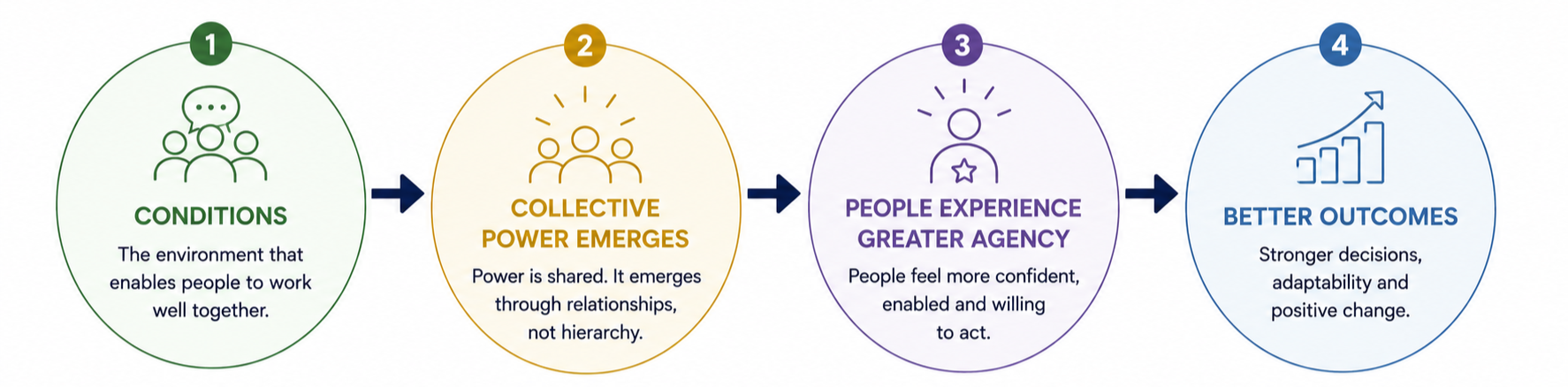
then hold people in the space and provide encouragement. It can become a virtuous cycle.
How leaders can create the conditions for collective agency
When agency emerges collectively, the role of leadership shifts from directing people to shaping the conditions in which they can work effectively together.
That means setting the conditions for a project, sharing power, holding people in the space and providing encouragement. It can become a virtuous cycle: people experience what they can achieve together, their confidence in one another grows, and they become more willing to take the initiative next time.
Much of this is practical. What happens in your meetings? Does seniority determine who gets heard, or can people contribute as equals?
There are also less visible conditions: whether people feel they belong, whether they believe they will be listened to, whether they trust one another, whether they feel safe enough to say something unpopular, and whether disagreement can be used productively rather than avoided.
These things affect the amount of agency people can exercise.
Working with uncertainty rather than trying to eliminate it
There is another condition that is particularly important in higher education: how you respond when things don’t go according to plan.
In complex organisations, uncertainty can trigger a desire for more control – more process, more detailed planning, more direction.
It is an understandable attempt to manage the unknown, but complex systems keep producing surprises. New information arrives. Something changes. Someone can’t turn up to a meeting. A dependency you hadn’t noticed suddenly becomes important. The plan that seemed sensible last week is no longer so relevant.
If the response to every unexpected event is to stop and seek complete certainty, work becomes slow and people learn to wait for permission.
An alternative is to establish some shared norms for what happens when the unexpected occurs.
Not another policy, and not detailed rules to legislate for every possible situation. Just a handful of reliable moves that people understand and can use when the plan stops being useful.
For example, a norm that everyone has the opportunity to speak in a meeting, or that challenge is directed at ideas rather than people.
You might agree that when new information emerges, the first question is whether it actually makes a material difference to a decision.
You might have a shared understanding that sometimes something is good enough for now, safe enough to try, and that decisions can be revisited when new information becomes available.
These are not fixed rules. They are ways of navigating complexity.
You can apply the same principle to faculty guidelines. You might agree that departments meet at least once a term, and that leadership teams meet at least twice, without prescribing exactly how those meetings work or what needs to happen in them, or preventing them from meeting more frequently.
The idea is to leave enough autonomy for people to work out what is appropriate in their particular context.
I think this is important because confidence doesn’t come from knowing exactly what will happen next. It comes from knowing how you will respond when something unexpected happens.
Five practical ways to build collective agency in your team
If you want to start building these conditions in your own team, here are six practical places to start:
1. Create more equal spaces for contribution
Look at your meetings. Who speaks first? Who speaks most? Whose expertise has the most weight? Experiment with meeting structures that make it easier for people to contribute regardless of their position.
2. Pay attention to psychological safety
Do people contribute freely, are they holding back? Is there someone on the team that is making communication difficult or making others hesitate? That needs addressing – that’s a negative expression of power that will diminish agency. It’s unlikely to resolve itself and will need you to explore the dynamics and support a shift.
3. Make informal networks visible
Encourage people to build relationships beyond their reporting line. When someone is stuck, ask who else might know about this? rather than automatically escalating upward.
4. Agree a few useful norms
Don’t try to prescribe every behaviour. Agree some simple ways of working to navigate uncertainty: everyone gets heard; challenge is welcome; “good enough for now, safe enough to try” is acceptable.
5. Notice where people are waiting for permission
When someone brings you a problem, resist the urge to solve it immediately. Ask what they think should happen, and what they could do without your permission.
6. Pay attention to what happens when plans change.
When something unexpected happens, notice whether your team’s instinct is to stop and seek certainty, or to gather, make sense of what has changed and decide what to do next. That tells you where agency sits in your system.
Making collective agency part of how you work
Perhaps the question for you as a leader isn’t simply, how do I empower my people?
That question still puts you as leader at the centre, as though agency is something handed down.
A more interesting question is: how do I create and maintain the conditions where people can exercise power together?
That means paying attention to relationships, and patterns of behaviour in the organisation.
When people trust one another, when different expertise is valued, and when people have enough autonomy to respond to reality rather than waiting for someone more senior to tell them what to do, people start to act collectively.
They solve problems that weren’t formally assigned to them, bring others into the work and spot opportunities that weren’t visible before. They respond to what is happening rather than simply following the plan.
None of this means that formal authority becomes irrelevant. Universities still need structures, accountability and decision-makers.
But perhaps leadership isn’t always about holding the power.
Sometimes leadership is about creating the conditions in which people can draw on each other’s power.
When that happens, agency becomes more than an individual capability, it becomes a property of the group.
Maybe agency, and the power to act, really is a team sport.
Key takeaways: Collective agency in higher education
What is collective agency?
Collective agency is a group’s capacity to act together, drawing on the knowledge, relationships, authority and influence of its members to achieve things they couldn’t accomplish alone.
Why does it matter?
Many challenges in higher education cross departmental and professional boundaries. Progress depends not just on individual capability, but on how effectively people can work together.
What can leaders do?
- Create space for people to contribute regardless of seniority.
- Build trust and psychological safety so people can challenge assumptions and ask for help.
- Connect people across organisational boundaries and informal networks.
- Agree shared norms that help people respond when plans change.
- Give teams autonomy to act within clear boundaries, rather than requiring permission for every decision.
What’s the key leadership shift?
Move beyond asking how to empower individuals. Ask how to create the conditions in which people can exercise power together.
Putting collective agency into practice
- For Higher Education Leaders:
Explore how power, relationships and collective agency shape the way people work together. Swap notes on management challenges and leadership approaches in our monthly online peer support group: Register for the next peer support call. - For Leadership Teams:
Want to build the conditions for collective agency, strengthen collaboration across organisational boundaries, or develop managers who can share power and help people navigate complexity? Get in touch with ThenSomehow. - Free Tools & Next Steps:
Explore our free Rapid Improvement toolkit to discover how cross-functional teams can work together on live problems, build agency and deliver improvements. You can also try our free 360 feedback tool, AdviceSheet, to gather perspectives on how people experience working together.