
If you work in Higher Education, you may recognise the gap between leadership development programmes and the realities of day-to-day organisational life. This piece explores why that gap exists – and what leadership development might need to become if it is to genuinely make a difference.

Image: Getty Images / Unsplash
This is what is wrong with leadership programmes
If you work in Higher Education, you will probably recognise this pattern. Universities invest significant time and money in leadership development. Programmes are commissioned. Cohorts attend workshops. Participants often enjoy them and report positive experiences. And yet, when people return to work, many institutions see little shift in how decisions are made, how teams collaborate, or how change actually happens.
This is not because leadership development is pointless. But there is a growing gap between how leadership is developed and how universities actually function.
The context matters here. UK Higher Education is operating under sustained pressure and uncertainty. The Office for Students reports that around 45% of universities are forecasting deficits.
In England, universities now receive roughly two-thirds of the real-terms funding per student that they did a decade ago – a gap of around £6.4bn across the sector – forcing institutions to do more with less while navigating digital change, workload concerns and organisational restructuring
In this context, leadership has become harder, not easier. Many of the challenges leaders face today are not technical problems with clear solutions, but relational, behavioural and organisational challenges: leading through uncertainty, working across boundaries, and helping teams function well under pressure.
And yet much leadership development still assumes organisations are stable, predictable places where leadership is primarily about knowledge, models and individual capability.
And a faculty leader said something to me last year that might sound familiar:
“We estimate around 150 people across the institution could benefit from leadership and management development. But we’ve only been offered two places on the existing programme.”
Across HE, there is a genuine hunger to develop current and future leaders and managers. But programme places are limited. Costs are high. Access can feel rationed. Even where participation is strong, institutions are not always seeing the shift they hoped for.
The myth of leadership with a big ‘L’
One of the quiet assumptions still shaping much leadership development is the idea of Leadership with a capital L – something located in a role and often heroic in nature. Leadership that knows the answers, can predict the future and provide the comforting certainty we all crave.
There are some examples of that on the left of this table:
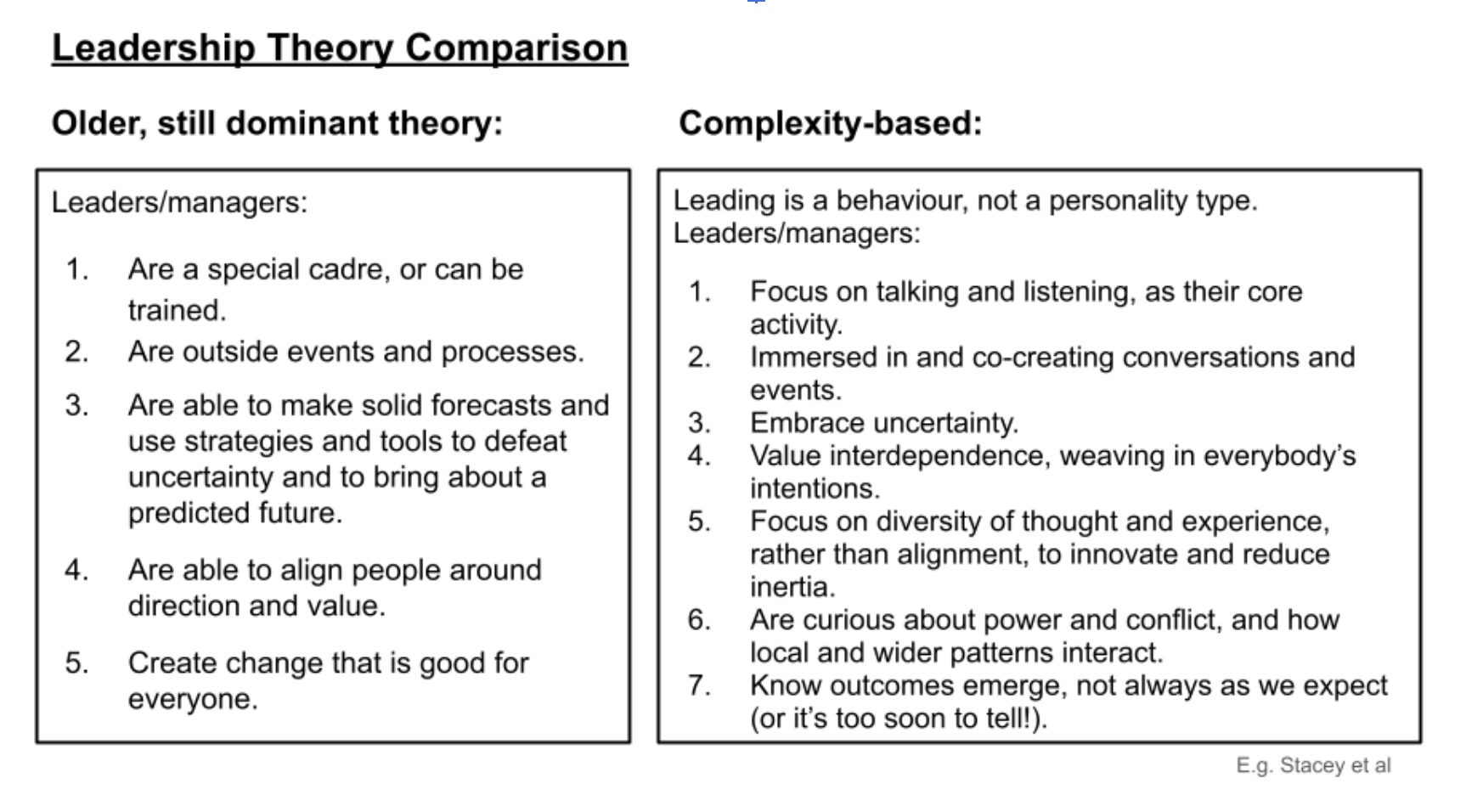
So when people come away from leadership programmes believing title + course certificate = everything you need to do the job well, discovering none of that works in the real world is discomforting for the individual and even more so for the people they hope to lead.
Instead real leadership comes with a small ‘l’ and shows up in micro-bursts:
- In a corridor conversation that unblocks a project
- In how people in a meeting handle disagreement
- In whether a colleague feels able to name what is not working, or ask a question<
It’s the difference between leadership as a noun and leadership as a verb. Small ‘l’ leading is all about what you do, not what you are.
Because leading is a behaviour, not a job title.
Leadership in HE is profoundly behavioural and relational, and it’s happening everywhere in every interaction that builds trust, confidence, clarity, safety.
And yet so many programmes still implicitly treat leadership as something that can be installed through the right combination of frameworks, 360s and intensive workshops.
There is useful learning in all of those things. But the gap between theory and practice is wide.
For example a client of mine who had completed an L5 leadership apprenticeship programme shared their disquiet at some of the course content:
“I loved the stuff about difficult conversations, communication styles and personality types. Some of it just seemed like common sense, but in some modules there was an implicit treatment of human beings as ‘resources’ or cogs in the machine that seemed off to me.”
It is a bit like learning to drive. Passing the theory test is not the same as driving in traffic. Capability only develops through practice, feedback, and growing confidence over time.
Leadership development that doesn’t connect to the real work and experiences of participants risks stopping at the equivalent of the driving theory test.
To explain this further, I love these two models of organisations. The one on the left is what much theory pretends is real. The one of the right hints at the actual reality. Leadership development needs to embrace that complexity.
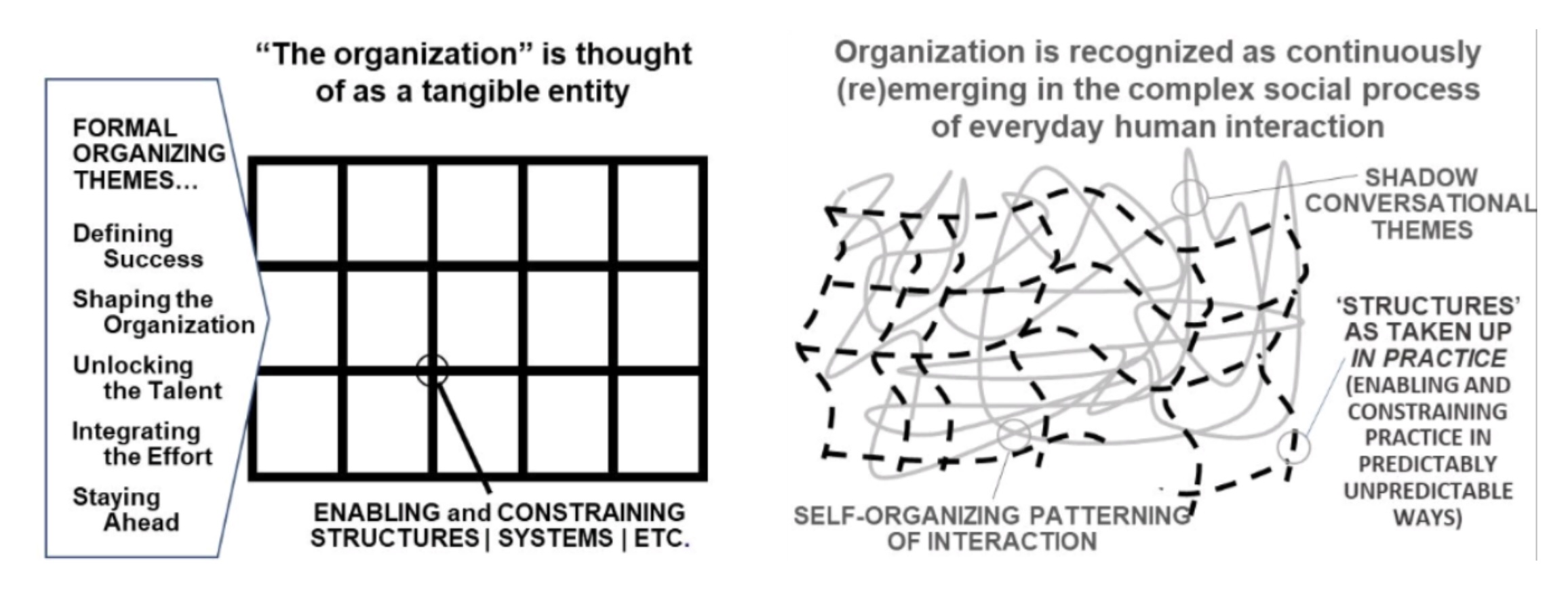
A desire to reduce things to simple ‘truths’ fails us because life, and work, it turns out, is messy, chaotic and unpredictable.
Why the assumption persists
If this mismatch is reasonably well understood, why do traditional models of leadership development persist?
Partly because they offer emotional and organisational comfort.
Structured programmes feel rigorous. They are defensible. They are controllable. A seven-step framework gives the reassuring sense that leadership capability can be built methodically and safely.
By contrast, approaches that emphasise feelings, needs, identity, experimentation and iteration can feel – especially in complex institutions – challenging.
Steve Hearsum captured this dynamic well in No Silver Bullet: organisations can, sometimes unintentionally, collude in the myth that the right model will unlock the change they need.
But leadership in universities is rarely that linear.
Leadership doesn’t live in a classroom
Another of the quiet assumptions behind many programmes is that leadership can be meaningfully developed away from the work itself.
But when participants return to their institutions, they step straight back into the same meetings, the same pressures, the same informal norms about what is and isn’t safe to say.
What made sense in the classroom is multidimensionally more complicated in the real world.
What we should be emphasising in development programmes is practising the relational skills and behavioural habits that have the most impact. Then taking that into the field.
Because leading is not easy. It is shaped by identity, confidence and — crucially — context. When development happens in isolation from the relational realities of the workplace, its impact has limits.
We need to equip people to deal with stuff that’s real like:
- Rewiring committee processes that slow decisions
- Flipping the quiet ‘waiting for approval’ culture that stalls initiative
- Flushing out bureaucracy slop where the process has become more important than the outcome
- Calling out poor behaviours in peers and leaders
We all recognise these leadership challenges. It’s not a knowledge or visibility issue. Most people involved understand perfectly well what’s wanted. Making it happen is considerably harder.
Shifting the relational patterns and risk calculations that shape behaviour in the moment. That’s what leaders could usefully learn how to do.
Leadership development that does not engage with these lived dynamics risks missing the point – however well designed it is.
A different approach
Over the past few years, we have been exploring a different approach.
Not a replacement for all formal development, and certainly not a silver bullet. More a living experiment grounding leadership learning in real work and real relationships.
Two design principles have mattered most.
- First, scalability and accessibility.
If leadership capability truly lives throughout the institution, development needs to reach beyond small cohorts of nominated senior or high-potential participants. - Second, mindset shift.
Less focus on acquiring theoretical leadership knowledge, and more on developing leadership as a practice embedded in day-to-day work.
It is worth saying that this approach is not universally loved.
In one pilot, around 70% of participants found it energising and highly relevant. But 30% did not. In fact they hated it. That ‘Marmite’ pattern was instructive.
Some colleagues are understandably looking for clarity, structure and prescription: “just tell us what to do”. Many traditional programmes provide exactly that reassurance.
But if the goal is adaptive capacity in complex environments, the work needs to be a little more alive – and a little less tidy.
What actually makes a difference
From what we are observing, traditional leadership content is not useless. Conceptual clarity still matters.
But sustained growth in capability tends to come from a different mix:
- Practising listening in live situations
- Handling difficult conversations earlier and more directly
- Surfacing unspoken needs within teams
- Working collaboratively and in safety on real institutional challenges
- Iterating and adapting and learning in the flow of work
As an illustration, we were recently working with a cross-institution group exploring how meetings were functioning in order to make them more effective. Most participants arrived with visibly low expectations, sitting with arms folded and a “how soon can I get out of this?” look on their faces. They were braced for the standard lecture on ‘good practice’ and ‘proven’ leadership models.
But we didn’t do that. Instead, we started a genuine inquiry into their actual experiences, inviting their best guesses on why things were stalling and holding a space where different points of view could be aired.
When the group realised we weren’t there to lecture, but to facilitate a real conversation about their committees and projects, the atmosphere changed.
Shoulders softened. Arms gradually uncrossed. People began speaking more candidly about where decisions were looping or energy was draining away.
It wasn’t a dramatic breakthrough, but a visible shift in how safe the room felt, and how willing people were to engage with the real work.
Moments like this capture the relational, practice-based side of leadership, where learning is embedded in doing and noticing rather than in frameworks or models.
Small intentional shifts compound
Through practice and iteration we have seen:
- Better quality conversations at senior levels
- Coalitions forming across organisational boundaries
- Issues being surfaced earlier, when they are still workable
- A gradual strengthening of psychological safety in operational spaces
Keep making small steps like that and over time it all adds up.
It was simple practices that enabled the shifts in the case above. For example:
- Ending meetings with three minutes of “what have we not said yet?”
- Building lightweight cross-team check-ins around live work
- Explicitly naming where decisions feel stuck and why
None of these look like major interventions. But repeated consistently, they begin to reshape what becomes discussable.
Reframing leadership development
Leadership development in Higher Education could use a gentle reframing. Let’s make it…
- Less about episodic knowledge transfer. More about context-informed practice.
- Less purely individual. More explicitly relational and collective.
- Less one-off. More iterative and sustained.
In essence, leadership as something you practise, reflect on, and refine continuously in live situations — rather than something primarily acquired through attendance.
If leadership is more a thing you do than a thing you are, let’s help people do it.
Several institutions are already moving in this direction.
A final thought
Leadership development in HE is not completely broken, but there is room for improvement.
In many institutions programmes emphasise an individualistic approach to equip people to solve systemic problems. If you’re noticing that people come back from programmes energised but the wider culture remains stubbornly unchanging, it may not be a failure of the individuals involved.
It may simply be that the development focus needs to move closer to the real dynamics of how teams and organisations operate day to day.
And the good news is – that is work that can be done.
What you can do next
If this resonates, here are two simple next steps you might take:
- Start a conversation in your team: Where does leadership feel stuck in our day-to-day work, not just in theory?
- Review your current offer: Is most of your investment focused on individuals, or on how teams actually work together? Is the emphasis theoretical or practice based? Is it available to the many or the few?
And if you’re exploring how to help leadership development translate into real cultural movement in your institution, I’d be very happy to compare notes.
👉 If this resonates – and you’re navigating change, culture shifts, or leadership questions in your institution – I’d be glad to talk about how to support your teams to work together better. Get in touch or book a call here.